


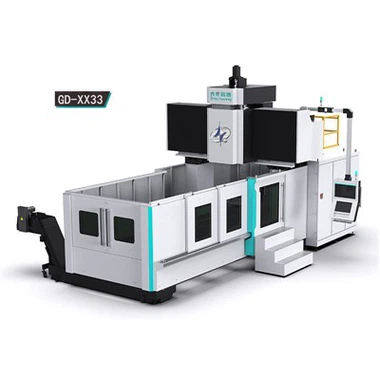
Product name: 5 axis gantry milling machine
Model No.: GF-4127
X-axis travel: 4100mm
Y-axis travel: 2700mm
Z-axis travel: 1000mm
Table area: 4000*1800mm...
Moving Column Five-axis Machining Center
What is Moving Column Five-Axis Machining Center
Moving column five-axis machining center provides infinite possibilities as to the part sizes and shapes you can effectively process. The term “5-axis” refers to the number of directions in which the cutting tool can move. On a 5-axis machining center, the cutting Tool moves across the X, Y and Z linear axes as well as rotates on the A and B axes to approach the workpiece from any direction.
Benefits of Moving Column Five-Axis Machining Center
Multi-Axis Movement: A moving column five-axis machining center has the ability to move its cutting tool along five different axes: X, Y, Z, as well as two rotary axes typically referred to as A and B. This enables complex and contoured machining from various angles without requiring repositioning of the workpiece.
Increased Precision: The additional axes of movement allow for intricate and precise machining of complex geometries. This is particularly useful for producing parts with intricate curves, undercuts, and complex shapes.
Reduced Setups: Traditional machining centers often require repositioning and multiple setups to achieve various angles and contours. With a moving column five-axis machining center, many operations can be completed in a single setup, reducing the need for extensive repositioning and setup time.
Improved Surface Finish: The multi-axis movement of a moving column five-axis machining center allows for smoother tool paths and better control over cutting angles. This results in improved surface finishes on the machined parts, reducing the need for additional finishing processes.
Shorter Production Time: The ability to machine complex features in a single setup reduces production time significantly. This is especially valuable for industries with tight production schedules and high demand.
Enhanced Tool Life: 5-axis machining enables better tool engagement with the workpiece, distributing wear more evenly across the cutting edges. This can extend the life of cutting tools, reducing tool changeovers and associated downtime.
Complex Contouring: With 5-axis capabilities, machining centers can execute intricate contouring and sculpting operations that would be challenging or impossible with conventional 3-axis machines.
Machining Difficult Materials: The flexibility of a moving column five-axis machining center allows for efficient machining of difficult-to-cut materials such as titanium, hardened steels, and exotic alloys, which might pose challenges for less versatile machines.
High Precision in Tight Spaces: The rotational axes allow the tool to access tight and difficult-to-reach spaces that might be unreachable with traditional machining methods.
Reduced Scrap and Rework: The accuracy and precision of moving column five-axis machining center contribute to fewer errors and less scrap material, minimizing the need for rework and enhancing overall manufacturing efficiency.
-
![5 Axis Gantry Milling Machine GF4127]()
-
![5 Axis Gantry Milling Machine GF4127]() 5 Axis Gantry Milling Machine GF4127A milling machine with a horizontal long bed and a gantry frame is referred to as a 5 axis gantry milling machine gf4127. Numerous cutters can be used at once to process the surface on the 5 axis...read more
Why Choose us
Cutting-edge technology
The company combines Taiwan technology and production team, fully utilize rich materials, human resources and core technology of Taiwan intelligent mechanical equipment industry, and continuously introduces Japanese assembly technology.
Commitment to quality
We're committed to quality and concrete actions. That means we always deliver solutions in a professional and practical way.
Client Satisfaction
We strive to provide superior customer service and ensure a clear communication, timely responses, and a focus on delivering solutions that exceed expectations.
8 Important Facts About Moving Column Five-Axis Machining Center And High-Performance Machining

1. You don't need 5-axis work to justify a moving column five-axis machining center
Do I need a machine? Many shops hesitate to make the considerable investment in a moving column five-axis machining center because they're not making the turbine blades, blisks, orthopedic implants and similar parts that are plastered over the front of any 5-axis machine brochure. Don't worry about it; you generally don't need simultaneous 5-axis work to justify a moving column five-axis machining center. Any part that gets machined on more than one side will benefit from the reduced part handling that comes with 3+2 machining, allowing completion of five of the six sides of most any orthogonal workpiece.
2. 5-axis machining on a multitasking lathe might be more effective than on a moving column five-axis machining center
Maybe your parts are more round than they are orthogonal but still contain features that lend themselves well to 5-axis machining. It might be time to consider a multitasking lathe or moving column five-axis machining center. These offer much of the same functionality as moving column five-axis machining centers and are able to produce complex, multisurface workpieces, but because they often carry a secondary spindle, many parts can often be completed in a single operation.
3. Why you cannot use a trunnion instead of a 5-axis machine
Perhaps you're thinking that you'll slap a tilt-rotary trunnion table on one of your moving column five-axis machining centers, thereby eliminating the need for a 3-axis mill. There's nothing wrong with this approach and it is a good way to get started with moving column five-axis machining center, but just bear in mind that a dedicated 5-axis machine tool carries control options such as tool center point control (tcpc), 5-axis auto-tuning, dynamic work offsets, and other features designed to make setup fast and easy, never mind a far more rigid, accurate machine construction.
4. All moving column five-axis machining centers are not alike
Speaking of machine construction, be aware that in moving column five-axis machining center land, not all machine tools are built alike. Three distinct styles of machine are available— those with tilt-rotary tables integrated to what is basically a moving column five-axis machining center; those machines with an integrated tilt-rotary but are using a traveling x-axis column—and those machines where the milling head swivels left to right above a rotary table-equipped bed. Each has its pros and cons, and buyers must consider things such as tool interference, workpiece size, required part accuracy and machine cost to make the best decision for their particular application.
5. Fixturing multiple parts is easier than you think: You are not limited to single parts
You might have heard that moving column five-axis machining center means you can only produce one part per machine cycle. Not true. Granted, the most common method for gripping parts on a moving column five-axis machining center is a single, extended height vise that clamps a pre-machined dovetail at the bottom of the workpiece blank. But for those who need to machine 3, 4, 6 or more parts per cycle, there are an increasingly broad array of workholding options available. The result is that fixturing multiple parts on a 5-axis machine is easier and more flexible than you might think.
6. You don't have to dovetail your own blanks
Did someone say dovetail? If you're dreading the thought of not only having to saw workpiece blanks but then cut the dovetails on them as well, you might consider focusing on what you're best at and ordering pre-cut, pre-dovetailed material from your steel supplier. You should also take a look at vises that rely on a series of pins, knife edges or even photo-activated glue to securely hold workpieces in place.
7. Improved accuracy, less handling with moving column five-axis machining center
Consider the traditional machining methodology whereby a 6-sided part requires six separate handlings and multiple fixtures to complete. As any machinist knows, no matter how well-designed the fixture, some small amount of part accuracy is lost with each operation. Since 5-axis completes all but the bottom of the workpiece without repositioning the part, the only thing preventing perfect accuracy is the machine tool itself.
8. ‘Done in one' moving column five-axis machining center is fun
A well-known machine tool builder suggests that adopting a “done in one” machining approach is one of the best things you can do for your shop's bottom line. They're right. With 5-axis, the baskets and bins of partially completed workpieces sitting around the shop are history. Cash flow is improved. Lead times are reduced while flexibility is increased. The burrs created when breaking into an intersecting feature are easier to remove.
Difference Between 3-Axis And Moving Column Five-Axis Machining Center
|
Difference |
3-axis |
Moving column five-axis machining center |
|
1. |
Materials are fed and worked on only 3-axis – Axis X, Y & Z. |
Materials are fed and worked on moving column five-axis machining center – Axis X ,Y, Z, A & B / C. |
|
2. |
Difficult to handle complex parts in one setting as well as workpieces that have deep and narrow cavities or shapes. Limitation due to the 3D-axis movement. For more complex operations, parts need to be repositioned and clamped in custom made fixtures. |
Built for complex parts with highly accurate machined results. Can use shorter cutting tools with faster tool speeds at a lower vibration level. This greatly saves time and effort in machining while allowing for more sophisticated parts to be made. Capable of reaching 5-sides on any part to achieve complex contours. E.g. Impeller, Tire Mold, 3D shaped parts. |
|
3. |
To achieve quality surface finishes, parts may need to be repositioned. Not only will this take additional time but the possibility for errors is high. |
Moving column five-axis machining centers are able to position the parts to the cutting tool in an optimum position to each other (90 degree). At the same time, all 5 sides of a part can be reached. Even the most complex contours and shapes can be machined by simultaneously utilizing all 5-Axis. |
|
4. |
Fewer axes make programming simpler with faster preparation and turnaround time. |
CAD/CAM systems are used to easily programme complex operations. |
Working Principle Of Moving Column Five-Axis Machining Center
The working principle of moving column five-axis machining center mainly depends on its five moving axes: X-axis, Y-axis, Z-axis and two rotating axes (usually A-axis and C-axis). The movement of these axes is precisely controlled by the CNC system, so that the tool can move and rotate freely in three-dimensional space, and realize the precise processing of complex workpieces. Specifically:
The X-axis, Y-axis and Z-axis represent the three linear coordinate axes of the machine tool, which are used to control the movement of the tool in the horizontal, vertical and depth directions. Through the combined movement of these three axes, the tool can be accurately positioned at any position on the workpiece, ready for subsequent processing.
The A-axis and C-axis are two rotating axes, where the A-axis rotates around the X-axis and the C-axis rotates around the Z-axis. The introduction of these two rotating axes enables the tool to process the workpiece at different angles and directions. Through the rotation of the A-axis and the C-axis, the workpiece can be processed at multiple angles and multiple surfaces, thereby greatly improving the processing efficiency and processing accuracy.
During the machining process, the CNC system of the moving column five-axis machining center plays a vital role. It controls the movement of the stepper motor or servo motor of each axis through the computer according to the pre-programmed machining program to achieve control of the workpiece machining. At the same time, the CNC system can also monitor the tool position, cutting force and other parameters in real time during the machining process to ensure the accuracy and quality of the machining.
In order to ensure the high-precision machining of the moving column five-axis machining center, the machine tool structure and transmission system need to have sufficient rigidity and stability. This is because, during the machining process, the interaction between the tool and the workpiece will generate large cutting forces and vibrations. If the machine tool structure and transmission system are not rigid enough, it is easy to cause machining errors and workpiece deformation. Therefore, the machine tool structure of the moving column five-axis machining center is usually made of high-strength materials, and the transmission system uses high-precision bearings, guide rails and other components to ensure the stability and accuracy of the machining process.
In addition to the requirements of the machine tool structure and transmission system, the CNC system of the moving column five-axis machining center also needs to have a high degree of intelligence and adaptability. This is because, in the actual processing, the material, shape, size and other parameters of the workpiece may change. If the CNC system cannot adjust the processing parameters and processing paths in real time according to these changes, it will easily lead to processing errors and scrapped workpieces. Therefore, the CNC systems of modern moving column five-axis machining centers are usually equipped with advanced adaptive control algorithms and intelligent learning functions, which can automatically adjust the processing parameters and processing paths according to real-time data during the processing to ensure the accuracy and efficiency of the processing.
Our Factory
Hubei Qixing Jingchuang Intelligent Equipment Co., Ltd. is professional manufacturer who focus on the R&D, testing and production of intelligent mechanical equipment, it's founded on August 30,2023 and locates in Suizhou, Hubei province, China. The company has an excellent research and development team, rich professional experience and high-end processing equipment, we constantly develop new excellent products, effectiveness for China's equipment manufacturing industry to make a great contribution.
The company adopts modern enterprise management idea, a large number of advanced Taiwan production technology and the most strict quality control, to provide customers with the most stable intelligent mechanical equipment, at the same time, we make the most efficient production plan for customers to realize the optimal production line for the customer and also promote excellent competitive advantage for the customer.
The company combines Taiwan technology and production team, fully utilize rich materials, human resources and core technology of Taiwan intelligent mechanical equipment industry, and continuously introduces Japanese assembly technology. The all key components are insisted to use well-known German and Japanese brands, it pays attention to every detail with a rigorous attitude, and carefully ensures that every machine delivered to customers can satisfy and reassure customers.
In terms of after-sales service, we strive to realize the commitment to customers. The professional sales service technical team provides customers with perfect, fast and professional service support, with sufficient spare parts and good training mechanism, to ensure that every equipment given to customers can operate well and continuously.
The products developed and produced by the company have the future development potential and their excellent core competitiveness. Thanks to the support and affirmation of the same industry, the company's operating resources are more abundant. The company will surely reach another new milestone for the vision of independent production of Chinese equipment.


Our Certificate


Asked Questions
We're professional moving column five-axis machining center manufacturers and suppliers in China, specialized in providing high quality customized service.. We warmly welcome you to buy moving column five-axis machining center for sale here from our factory. For price consultation, contact us.
moving column five axis machining center